Ask beginner guitarists which chord gave them the most trouble and most will say the same thing: F. You can strum C, G, Am and Em with ease, then a song throws in an F or a Bm and everything falls apart. Strings buzz, notes go dead, your fingers hurt, and some players quit right there. The good news is that barre chords don't need superhuman strength. They need the right technique and a little steady practice. Here's how barre chords work and how to make them ring clean on both guitar and ukulele.
What is a barre chord?
A barre chord is any chord where one finger, usually the index, presses down several strings at the same fret. That finger acts like a built-in capo, and your other fingers form a chord shape above it. The big payoff is that one shape becomes many chords. The F shape at the 1st fret turns into G at the 3rd fret and A at the 5th. Once you can play one barre shape, you can reach almost any major chord without memorizing a new fingering.
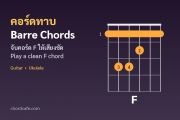
How to play F on guitar, step by step
- Index finger (1): barre all six strings at the 1st fret.
- Middle finger (2): 3rd string (G) at the 2nd fret.
- Ring finger (3): 5th string (A) at the 3rd fret.
- Pinky (4): 4th string (D) at the 3rd fret.
With the shape in place, pick each string one at a time from the 6th down to the 1st. Listen for any string that buzzes or goes silent, and fix that one spot. Don't strum the whole chord yet, or you won't know where the problem is.
Technique tips for a clean barre
- Use the side of your index finger: roll it slightly toward the headstock so the firmer, bony edge touches the strings. The soft pad and the creases at your knuckles are what usually mute strings.
- Stay close to the fret: the nearer your index finger sits to the fret wire, the less pressure you need and the cleaner it sounds.
- Don't just squeeze with your thumb: good pressure comes from gently pulling your arm back and letting its weight help, not from clamping the neck until your hand cramps.
- Keep your thumb behind the neck: place it around the middle of the back of the neck, roughly opposite your middle finger, so your other fingers can arch properly.
- Check your setup: high action or heavy strings make barre chords much harder. A setup at a guitar shop or lighter-gauge strings can make a real difference.
Barre chords on ukulele
Ukulele players get a break: F on the uke is an easy open chord (2010). The chord that trips people up is Bb, which is a barre. Here's how to play it:
- Index finger: barre the 1st (A) and 2nd (E) strings at the 1st fret.
- Middle finger: 3rd string (C) at the 2nd fret.
- Ring finger: 4th string (G) at the 3rd fret.
With only four nylon strings, a ukulele barre takes far less effort than a guitar one. Once Bb feels solid, slide the same shape up one fret for B and another fret for C.
Easier alternatives while you build up
You don't have to wait until your barre is perfect to play songs. Use these in the meantime:
- Fmaj7 (x x 3 2 1 0): a sweet-sounding substitute that works in many songs.
- Small F (x x 3 2 1 1): your index covers just two strings, a great stepping stone to the full six-string barre.
- Use a capo: move to a key without barre chords, for example capo up and play G- or C-shape chords instead.
A 10-minute daily practice plan
- First 2 minutes: barre with just your index finger at the 5th fret, where it takes less pressure than the 1st, and pick each string until they all ring.
- Next 3 minutes: form the full F chord, hold it for five seconds, let go, and form it again. Repeat.
- Last 5 minutes: practice switching C to F and F to G slowly with a metronome.
Sore fingertips and a few dead strings in the first week are completely normal, but if your wrist hurts or your hand feels very tense, stop and rest. With regular practice, most players hear a clear improvement within two to four weeks. Get past the barre chord and hundreds more songs on Chordcafe open up to you.