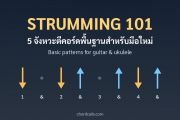
Plenty of players can hold their chords, yet when they start to play, the song feels stiff or the rhythm just doesn't sit right. Most of the time the problem isn't the fretting hand at all. It's the strumming hand. This guide covers five basic strumming patterns that fit most pop, folk and acoustic songs. They work on both guitar and ukulele, because the strumming hand does almost exactly the same job on both instruments.
Before you start: reading the patterns and counting
In this article, D means a downstrum, U means an upstrum, and a dash - means your hand keeps moving but misses the strings. Most songs are in 4/4 time, so count "1 and 2 and 3 and 4 and". The numbers are your downstrums and the "and"s are your upstrums.
There's one golden rule to remember: keep your strumming hand moving down and up all the time, like a pendulum, whether or not it touches the strings. That constant motion is what keeps your timing steady and stops you from losing the beat.
Pattern 1: All downstrums (D D D D)
This is the simplest pattern: one downstrum per beat, counted "1 2 3 4". It's perfect for your very first chord changes because it gives your fretting hand time to get ready, and it also sounds great in rock songs or any section that needs a solid, driving feel.
Pattern 2: Steady eighths (D U D U D U D U)
Strum down on every number and up on every "and". This builds the pendulum motion from the golden rule. Try accenting the downstrums a little more than the upstrums, and the pattern immediately sounds more musical.
Pattern 3: The all-purpose pop strum (D - D U - U D U)
This is the pattern you'll hear in countless pop and folk songs. Count it as "1 - 2 and - and 4 and". On beat 3 your hand still swings down but misses the strings, and that little gap is what gives the pattern its bounce. Get this one comfortable and you can play along with hundreds of songs.
Pattern 4: Reggae and ska off-beats (- U - U - U - U)
Here you only hit the upstrums, the off-beats. On guitar, keep each strum short and relax your fretting hand right after to choke the sound. On ukulele it gives a bright, beachy feel. It's great for upbeat songs and does wonders for your sense of the off-beat.
Pattern 5: 3/4 waltz time (D - D U D U)
Some songs count three beats per bar, like slow ballads and waltzes. Count "1 - 2 and 3 and", and give the downstrum on beat 1 a clear accent. You'll get that gentle, swaying dance feel.
Tips for a better strumming sound
- Relax your wrist. The motion should come from the wrist, not from swinging your whole arm.
- Hold the pick loosely. On guitar, let just a little of the pick stick out; gripping too hard makes the sound harsh. On ukulele, strum down with the nail of your index finger and up with the pad.
- Upstrums don't need every string. Catching the top three or four strings is enough, and it gives a lighter, brighter sound than the downstrum.
- Use a metronome. Start around 60 to 70 BPM and add 5 BPM at a time once the pattern feels steady.
A 10-minute daily practice plan
- Minutes 1 to 2: strum open or muted strings so you can focus only on your strumming hand.
- Minutes 3 to 6: pick one pattern and loop it on a single chord, then switch between two chords such as C and G.
- Minutes 7 to 10: put on a song you love and play along. Don't worry about hitting every strum perfectly; just keep your hand moving.
Remember that strumming patterns are guidelines, not strict rules. Once the basics feel natural, listen closely to the original recording and adapt the pattern to the mood of the song. Practice a little every day, then open the chords to your favourite songs on Chordcafe and play along.