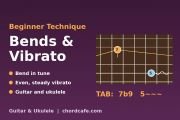
Ever heard a guitar solo where a single note seems to cry or sing? Behind that sound are usually two techniques: the bend and vibrato. Neither adds new notes. Instead, they add expression to the notes you already play. This guide explains what each technique is, how to keep it in tune, and how to practice it on both guitar and ukulele.
What is a bend?
A bend means fretting a note and then pushing or pulling the string sideways across the fretboard. The extra tension raises the pitch smoothly, like a voice sliding up. In tabs it is usually written with a b, for example 7b9: fret the 7th fret and bend until it sounds like the 9th. You will also see an arrow marked full (a whole step, two frets) or 1/2 (a half step, one fret).
How to bend in tune
- Use more than one finger. If you bend with your ring finger, place your middle and index fingers on the same string behind it and push together. You get more strength and more control.
- Power comes from the wrist. Rotate your wrist as if turning a door knob, with your thumb hooked over the top of the neck as a pivot.
- Hear the target first. Play the target note (say, fret 9), keep it in your ear, then bend fret 7 until it matches. This is the secret to bends that are not out of tune.
- Push high strings, pull low strings. On guitar, strings 1–4 are usually pushed toward the ceiling, while strings 5–6 are pulled toward the floor so they do not slip off the neck.
- Watch the other strings. A bent string can drag its neighbours into ringing. Mute unused strings with the side of a finger or your picking hand.
How far can a ukulele bend?
Ukulele nylon strings are stretchy and at low tension, so they will not bend as far as electric guitar strings. Most of the time you can get a half step to a whole step, and the note will not sustain as long. That is still plenty for adding colour to a melody. Bend around the middle frets (roughly 5–9), where the string moves most easily, and rely mainly on half-step bends. Steel-string acoustic guitars are also harder to bend than electrics, so start with half steps there too.
What is vibrato?
Vibrato is a small, rhythmic rise and fall in pitch on a sustained note, like a singer adding a gentle wobble to the end of a long note. It makes a note sound alive and confident. In tabs it appears as a wavy line (~~~) after the note.
Two kinds of vibrato
- Bend vibrato: tiny repeated bends driven by wrist rotation. This is the sound of rock and blues, and it works best on electric guitar.
- Classical vibrato: rocking your fingertip back and forth along the length of the string, toward the headstock and toward the body. The changing pressure gives a soft, warm wobble that suits classical guitar and the nylon strings of a ukulele.
Tips for vibrato that sounds good
- Evenness beats width. Good vibrato has a steady speed and depth. Avoid random shaking.
- Practice with a metronome. At 60 BPM, start with two wobbles per beat, then move up to three or four.
- Delay it slightly. Hold the note straight for half a beat before you start the vibrato. It sounds more natural than wobbling from the first instant.
- Do not squeeze too hard. A tense hand makes vibrato stiff and tires you out quickly.
A simple 5-minute daily drill
- Pitch-matched bends: on guitar, play fret 9 on the 3rd string, then bend fret 7 to match it. Repeat ten times. On ukulele, bend fret 6 on the 2nd string up to the pitch of fret 7.
- Bend, hold, release: bend up in tune, hold for two beats, then let it down slowly back to the starting note.
- Vibrato with each finger: choose one note and add vibrato with your index, middle, ring and little finger, four beats each.
- Add it to a scale: play the pentatonic scale slowly and add vibrato to the last note of each phrase.
Wrapping up
Bends and vibrato are what make your playing speak rather than just hitting the right notes. Start with in-tune half-step bends and steady vibrato, practise a few minutes a day alongside hammer-ons, pull-offs and slides, and your solos will quickly sound more expressive. Pick a favourite song on Chordcafe and try adding these touches today.