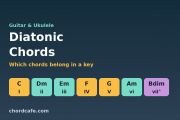
Ever wondered why most songs keep cycling through the same handful of chords, and why some chords sound great together while others feel out of place? The answer is diatonic chords, the set of chords that naturally belong to a key. Once you understand them, working out songs by ear, guessing the next chord and writing your own progressions all become much easier. The idea works exactly the same on guitar and ukulele.
What are diatonic chords?
Every major key is built from seven notes. The key of C major, for example, uses C D E F G A B, with no sharps or flats. If you build a chord on each of those notes using only notes from the key, you get seven chords. Those are the diatonic chords of the key. Because they all share the same pool of notes, they fit together naturally, which is why most pop songs draw almost all their chords from this group.
The pattern to remember: major, minor, minor, major, major, minor, diminished
In every major key, the chord qualities follow the same order. Musicians often label them with Roman numerals: uppercase for major chords and lowercase for minor chords.
- I – major (the home chord of the key)
- ii – minor
- iii – minor
- IV – major
- V – major (creates a pull back toward I)
- vi – minor (the relative minor of the key)
- vii° – diminished (rarely used in pop)
Memorise "M m m M M m dim" and you can apply it to any key.
Diatonic chords in common keys
- Key of C: C – Dm – Em – F – G – Am – Bdim
- Key of G: G – Am – Bm – C – D – Em – F#dim
- Key of D: D – Em – F#m – G – A – Bm – C#dim
- Key of A: A – Bm – C#m – D – E – F#m – G#dim
- Key of F: F – Gm – Am – Bb – C – Dm – Edim
On guitar, the keys of G and C are the most beginner-friendly because most of their chords are open shapes. On ukulele, C, G and F are especially comfortable, since C, Am, F and G need only a few fingers.
How this helps you learn songs
Once you know a song's key, you can make a good guess at the rest of its chords. A quick way to find the key is to look at the first and last chords, which are often the I chord. If a song starts and ends on G, it is very likely in G, so the other chords will probably be C, D, Em or Am. That narrows your options dramatically when you are playing by ear.
The most famous progressions are all built from diatonic chords. I–V–vi–IV is C–G–Am–F in the key of C, and ii–V–I (Dm–G–C) is everywhere in jazz and ballads. Thinking in numbers also makes changing key simple: I–V–vi–IV in G becomes G–D–Em–C straight away.
Simple exercises to try today
- Walk through the key: Play the chords of C major in order from C to Am, four beats each, slowly. Listen to how each one feels different.
- Loop I–IV–V: Play G–C–D–G in the key of G. This shape underpins thousands of songs.
- Write a mini song: Pick any four chords from the same key, arrange them however you like and hum a melody over them. You will find that almost every combination works.
- Use a capo: If the key of G is too low for your voice, add a capo and keep the same shapes. The pitch goes up but the relationships between the chords stay the same.
Summary
Diatonic chords are a map that shows you which chords belong together. Remember the pattern major, minor, minor, major, major, minor, diminished and you can use it in any key, on guitar or ukulele. Next time you open a favourite song on Chordcafe, try working out which key it is in. You will start to see songs in a whole new way.