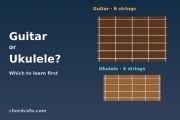
One of the most common questions from new players is simple: "Should I start with guitar or ukulele?" Both are strummed, chord-based instruments that are perfect for singing along, but they differ in ways that shape your first few months of learning. Here is a side-by-side comparison to help you choose your first instrument with confidence.
Size and weight
The ukulele is small, light and easy to carry. It comes in several sizes—soprano, concert, tenor and baritone—with soprano and concert being the usual picks for beginners. An acoustic guitar is much larger, with a longer neck and wider fret spacing. For children or players with small hands, a ukulele often feels comfortable from day one. If you want a guitar but worry about size, smaller models such as 3/4-size guitars are worth a look.
Strings and tuning
A ukulele has four strings, usually tuned G-C-E-A, and most use soft nylon strings that are gentle on the fingertips. A guitar has six strings tuned E-A-D-G-B-E. Most acoustic guitars use steel strings, which feel harder on your fingers at first; classical guitars are the exception, using nylon. Fewer strings means ukulele chords need fewer fingers and tuning takes less time.
How hard are the first chords?
The ukulele’s biggest advantage is that many basic chords use only one or two fingers. C needs a single finger, and Am and F are easy shapes too, so beginners can often play a first song within a few days. On guitar you work through G, C, D and Em, and you meet barre chords like F fairly early, which takes more practice to sound clean.
- Ukulele: quick early wins that keep motivation high
- Guitar: a tougher start, but it builds strong finger technique
Sound and musical styles
The ukulele has a bright, cheerful voice that suits light pop, acoustic covers, Hawaiian music and casual sing-alongs, but its range is narrow and it has little bass. The guitar covers a much wider range and works for pop, rock, blues, jazz and fingerstyle. If the music you dream of playing is rock or features big solos, the guitar is the better match.
Skills carry over
The good news is that whichever you pick first, nothing is wasted. The ukulele’s four strings share the same intervals as the top four strings of a guitar, just a fourth higher, so chord shapes look alike. For example, the guitar’s G shape on the top four strings becomes a C chord on the ukulele. Strumming, chord changes, ear training and basic music theory all transfer between the two.
How to choose
- Choose ukulele if you want to play songs quickly, have small hands, are buying for a child, want something to travel with, or love bright, easygoing songs.
- Choose guitar if you want rock, blues or a full, rich sound, plan to play in a band, or hope to move on to electric guitar.
- Still unsure? Try both at a music shop and pick the one you’ll want to pick up every day—motivation matters more than difficulty.
Tips for beginners on either instrument
- Get an instrument with a well-adjusted, low action; it makes pressing the strings far easier.
- Practise 15–20 minutes a day consistently rather than long sessions once in a while.
- Start with songs you love that use only a few chords—Chordcafe’s chord charts are a great place to begin.
- Tune up every time before you play so your ear learns what “right” sounds like.
There is no single right answer for everyone. The ukulele gets you playing fast and having fun, while the guitar offers more variety in the long run. Pick the instrument that fits the songs you want to play, and start practising today.