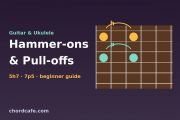
What are hammer-ons and pull-offs?
Ever wondered how some players make notes flow together smoothly, almost like singing, without picking every single one? Most of the time the answer is two fretting-hand techniques: the hammer-on and the pull-off. Both let you sound a new note without striking the string again with your picking hand. They work on acoustic guitar, electric guitar and ukulele alike, and they are an essential step before you move on to solos, riffs and more detailed fingerpicking.
- Hammer-on: pick a note, then quickly and firmly "hammer" a fretting finger onto a higher fret on the same string. The second note sounds without picking again.
- Pull-off: the reverse. Fret a higher note, pick it, then pull your finger off the string with a slight downward flick so the string keeps ringing at a lower fret (or open).
In tab, hammer-ons are usually marked with h and pull-offs with p. For example, 5h7 means pick the 5th fret and hammer onto the 7th, while 7p5 means pick the 7th fret and pull off to the 5th. Some tabs use a curved slur line connecting the two numbers instead.
Why beginners should learn them
- They make your playing sound smoother and more expressive than picking every note.
- They let you play faster passages without extra work for your picking hand.
- They dress up simple chords. A quick hammer-on inside an Am or C chord instantly gives you that folk and pop sound.
- They build strength and accuracy in your fretting fingers, which also helps your chord changes.
How to practise hammer-ons step by step
- Start with an open string: pick the open 3rd string (G), then hammer your index finger onto the 2nd fret. Keep your fingertip upright and land as close to the fret wire as you can.
- Be quick and decisive, like a small hammer. If you lower your finger slowly, the note will be weak or silent.
- Next, try it from a fretted note: hold the 5th fret with your index finger, pick, then hammer your ring finger onto the 7th fret (5h7).
- Listen for balance. The goal is for both notes to sound at roughly the same volume.
How to practise pull-offs step by step
- Fret the 2nd fret of the 3rd string with your index finger, pick once, then pull your finger away while slightly snagging the string toward the floor. Don't lift straight up. You should hear the open string.
- That little snag is the secret. Your fretting finger is effectively plucking the string.
- When you're ready, anchor your index finger on the 5th fret first, fret the 7th with your ring finger, pick, and pull off (7p5). Keep the index finger pressed down the whole time.
- Watch out for neighbouring strings ringing. Mute unused strings with spare parts of your fingers or your picking hand.
Three simple exercises
- Pentatonic slurs: play the A minor pentatonic scale in position 1 (frets 5–8). On each string, pick the first note and hammer to the second on the way up, then use pull-offs on the way down.
- Chord embellishments: on guitar, hold an Am chord with your middle finger lifted off the 4th string, pick the 4th string, then hammer the middle finger onto the 2nd fret. On ukulele, hold a C chord, pick the open 1st string, then hammer your ring finger onto the 3rd fret.
- Trills: alternate hammer-ons and pull-offs rapidly between frets 5 and 7, such as 5h7p5h7p5. This builds finger strength and stamina.
Common beginner mistakes
- Hammering too softly so the second note barely sounds. Fix it with speed and fingertip precision, not just pressure.
- Lifting straight up on pull-offs, which kills the note. Always give the string a small flick.
- Rushing the tempo. Start slowly with a metronome at 60 BPM and increase by 5 BPM at a time.
- Tensing up. Take a break every 10–15 minutes, especially while your fingertips are still building calluses.
Wrapping up
Hammer-ons and pull-offs are small techniques that make a big difference to how you sound. Spend five to ten minutes a day on them alongside your regular chord practice, and you'll soon start hearing them in your favourite songs and adding them to your own playing naturally. Open the chords to a song you love on Chordcafe and look for one spot where a hammer-on could fit.