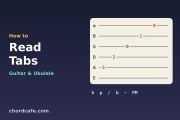
Chord charts are great for strumming along, but sooner or later you will want to play the intro riff, a short melody or a simple solo from a song you love. That is where tabs come in. Tablature, or "TAB", is a simple way of writing music for fretted instruments that shows exactly which string to play and which fret to press. You do not need to read standard notation at all. In this guide you will learn how to read guitar and ukulele tabs step by step.
What is a tab?
A tab is a picture of your instrument's strings laid flat. Each horizontal line is one string, and the numbers placed on the lines tell you which fret to press on that string. You read the tab from left to right, just like a sentence. Notes that come first appear further to the left.
- Guitar tabs have 6 lines (one for each string).
- Ukulele tabs have 4 lines.
- The top line is the highest-pitched string, and the bottom line is the lowest. This is the most common point of confusion, because it looks "upside down" compared with how you hold the instrument.
Reading the lines
For a guitar in standard tuning, the lines from top to bottom are: e (thin high E), B, G, D, A and E (thick low E). For a ukulele in standard tuning they are: A, E, C and G. Many tabs write these letters at the start of each line, so you can always check.
e|-----------------0---|
B|-------------1-------|
G|---------0-----------|
D|-----2---------------|
A|-3-------------------|
E|---------------------|
The example above is a C major chord played one note at a time: 3rd fret on the A string, 2nd fret on the D string, the open G string, 1st fret on the B string and finally the open high e string.
What the numbers mean
- 0 means play the string open, without pressing any fret.
- 1, 2, 3... is the fret number to press. "5" means press at the 5th fret.
- Two-digit numbers such as 10 or 12 are a single fret, not two notes.
- Numbers stacked vertically are played at the same time. That is how a chord is written in a tab.
- x means a muted string: touch it lightly so it makes a percussive "chk" sound with no pitch.
Common tab symbols
Once you know the numbers, you can add expression with these symbols. You will see them in almost every song tab online.
- h = hammer-on, for example 5h7: pick the 5th fret, then "hammer" a finger down onto the 7th fret without picking again.
- p = pull-off, for example 7p5: the opposite of a hammer-on. Pluck the string with your fretting finger as you lift it off.
- / and \ = slides, for example 5/7: play the 5th fret and slide up to the 7th while keeping pressure. A backslash means slide down.
- b = bend, for example 7b9: push the string sideways until the 7th fret sounds like the 9th fret.
- ~ = vibrato: gently wiggle the string to make the note shimmer.
- PM = palm mute: rest the edge of your picking hand on the strings near the bridge for a short, chunky sound.
What about rhythm?
The biggest weakness of basic tabs is that they usually do not show rhythm precisely. The spacing between numbers only gives a rough idea of timing. The best way to fix this is simple: listen to the original recording while you read the tab. Some tabs add rhythm marks above the numbers, and tab apps or software can play the tab back so you hear exactly how it should sound.
Tips for practising with tabs
- Start slowly. Play each note clearly at a slow tempo, then speed up gradually with a metronome.
- Learn in small chunks. Master one bar or one phrase at a time before moving on.
- Check the tuning. Look at the top of the tab for notes like "Capo 2" or "Drop D", and tune your instrument to match.
- Compare sources. Tabs online are often written by fans and can contain mistakes. If something sounds wrong, trust your ears and the original song.
- Combine tabs and chords. Use chord charts for the verses and tabs for the intro or solo. That is how most players learn a whole song.
Summary
Reading tabs comes down to three ideas: the lines are strings (with the highest string on top), the numbers are frets, and you read from left to right. Add a few symbols such as h, p, / and b, listen to the original recording for rhythm, and you can start playing the riffs and melodies from your favourite songs today. Pick a short intro, read it slowly, and enjoy the moment it starts to sound like the record.