Once you can switch between a handful of chords, it is natural to want more: a short melody between verses, a little fill at the end of a line, maybe even your first solo. Open any theory book, though, and you are faced with dozens of scales. If you only learn one, make it the pentatonic scale. It is easy to remember, it sounds good almost anywhere, and it works across pop, rock, blues, folk and country.
What is the pentatonic scale?
"Penta" means five, so a pentatonic scale has just five notes instead of the seven found in ordinary major and minor scales. The two notes it leaves out are the ones most likely to clash with the chords underneath. The result is a scale where almost any note you play over chords in the same key sounds right, which is exactly why beginners can start improvising with it so quickly.
There are two common types: minor pentatonic and major pentatonic. We will start with A minor pentatonic, made of the notes A, C, D, E and G. It is the most widely taught version and sits comfortably on the guitar neck.
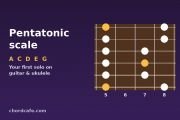
A minor pentatonic on guitar (box 1)
The first shape everyone learns is called "box 1" and covers frets 5 to 8. Keep your index finger on fret 5 and use your ring or little finger for frets 7 and 8. Starting from the thickest string (string 6):
- String 6 (low E): frets 5 and 8
- String 5 (A): frets 5 and 7
- String 4 (D): frets 5 and 7
- String 3 (G): frets 5 and 7
- String 2 (B): frets 5 and 8
- String 1 (high E): frets 5 and 8
Fret 5 on strings 6 and 1 is the note A, the root of the scale. When you improvise, try ending your phrases on this note and you will hear the music settle.
A minor pentatonic on ukulele
On a ukulele in standard G C E A tuning, the good news is that the whole scale lives in open position:
- G string: open (G) and fret 2 (A)
- C string: open (C) and fret 2 (D)
- E string: open (E) and fret 3 (G)
- A string: open (A) and fret 3 (C)
Use your middle finger for fret 2 and your ring finger for fret 3. The bright ukulele tone suits this scale beautifully, and it is perfect for short melodies between sung lines.
Minor and major pentatonic share one shape
Here is the shortcut that makes life easier: A minor pentatonic contains exactly the same notes as C major pentatonic (C, D, E, G, A). Only the home note changes. So if a song is in C major, typically using C, G, Am and F, you can play the very same finger pattern and simply aim to land on C. Leaning on C sounds bright and poppy; leaning on A sounds moodier, closer to rock and blues.
How to practise it
- Start slowly with a metronome, one note per click, at around 60–70 BPM, going up and down the scale.
- Say or think the note names as you play so the root positions stick.
- Play the notes in groups of three or four instead of only straight up and down, so your fingers get used to crossing strings.
- Put on a backing track in A minor and improvise over it. Begin with short three- or four-note phrases and leave space between them.
- Ten to fifteen minutes a day beats one long session a week.
Moving to other keys
On guitar, box 1 is movable. Place your index finger on the root note on string 6 and shift the whole shape: start at fret 3 for G minor pentatonic, or fret 7 for B minor pentatonic. On ukulele, if you want a new key without learning new positions, a capo does the job nicely.
Wrapping up
The pentatonic scale is the first door into soloing and improvisation. With only five notes and a shape that is easy to memorise, both guitar and ukulele players can start making up their own melodies within days. Pick a favourite song on Chordcafe in A minor or C major, strum the chords, and try slipping in a few notes from this scale. You will be surprised how much more fun playing becomes.