If you have ever listened to rock, punk or pop-punk and wondered how the guitarist gets that thick, driving sound, the answer is usually the power chord. It uses just two or three fingers, is far easier than a full barre chord, and a single hand shape can be moved to play in any key. This guide covers the simple theory behind power chords and how to practise them so they sound clean.
What is a power chord?
A regular chord such as C or Am contains three notes: the 1st, 3rd and 5th of the scale. The 3rd is the note that makes a chord major (bright) or minor (sad). A power chord leaves out the 3rd and keeps only the root and the 5th, sometimes adding the root again an octave higher. That is why power chords are written with a 5, such as E5, A5 and G5.
Without a 3rd, the chord is neither major nor minor. It sounds neutral and solid, and it stays clear even through heavy distortion, where full chords can turn muddy. That is the main reason power chords became the backbone of rock music.
Playing a power chord on the 6th string
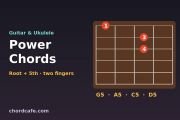
- Put your index finger on the 6th string (the thickest) at any fret. This is the root note and gives the chord its name.
- Put your ring finger on the 5th string, two frets higher.
- Optionally, add your pinky on the 4th string at the same fret as your ring finger.
- Strum only those two or three strings.
For example, with your index finger on the 6th string, 3rd fret, you are playing G5. Slide the same shape to the 5th fret for A5, or to the 8th fret for C5. The shape never changes; only its position does.
Power chords on the 5th string
Use the same shape, moved over by one string. Your index finger goes on the 5th string, and your ring finger and pinky go on the 4th and 3rd strings, two frets higher. Index finger on the 5th string, 3rd fret, gives C5; at the 5th fret you get D5. Using both string sets keeps your hand from travelling too far. Going from G5 (6th string, 3rd fret) to C5 (5th string, 3rd fret), for example, is just a move across one string.
If you don't know the fretboard yet, start by memorising a few notes. On the 6th string, open is E, the 3rd fret is G and the 5th fret is A. On the 5th string, open is A, the 3rd fret is C and the 5th fret is D.
Tips for a clean sound
- Mute the strings you aren't playing. Let the tip of your index finger lightly touch the string below the root, and let the underside of your fingers rest on the thinner strings. That way you can strum hard without stray notes ringing out.
- Try palm muting. Rest the edge of your picking hand on the strings near the bridge for a tight, chugging rock sound.
- Don't squeeze too hard. Press just enough for the notes to ring. Too much pressure pulls the notes sharp and tires your hand quickly.
- Move the shape as one unit. When changing chords, relax your grip slightly and slide your whole hand without lifting your fingers apart.
Power chords on the ukulele
A ukulele in standard G-C-E-A tuning can play power chords too, even if they won't sound as heavy as on guitar. Use your index finger on the C string (3rd string) as the root and your ring finger on the E string (2nd string), two frets higher, and strum only those two strings. For example, C string 2nd fret plus E string 4th fret gives D5, while the open C string with the E string at the 3rd fret gives C5. It adds a light rock flavour that is fun for short riffs.
Your first exercise
Play the progression G5 – C5 – D5 – C5 with four down-strums on each chord. Start with a metronome at 70–80 BPM. Once it feels comfortable, add palm muting and gradually raise the tempo. This kind of progression shows up in a huge number of rock songs.
Summary
Power chords are a great shortcut for beginners who want to play rock. They need only a few fingers, one shape works in every key, and they build a strong foundation before you tackle full barre chords. Practise for ten minutes a day and you will be playing your favourite riffs before long.