What is a seventh chord?
Open almost any song on Chordcafe and sooner or later you will see chords like G7, Cmaj7 or Am7. Many beginners wonder how they differ from plain G, C and Am, and whether it is fine to just skip the "7". You can, but the song loses a lot of its colour. Seventh chords are the seasoning that gives music its sweetness, its wistfulness and that feeling of wanting to move forward.
The basic chords you play every day are called triads. They contain three notes: the 1st, 3rd and 5th notes of a scale. A C chord, for example, is C–E–G. A seventh chord adds a fourth note, the one that sits seven scale steps above the root, which is where the name comes from. That seventh can be a major seventh or a minor seventh (half a step lower). Combine those with major and minor triads and you get the three seventh chords you will meet most often.
1. Dominant 7 chords (C7, G7)
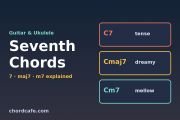
A chord written with just a 7, such as C7, is a major triad plus a minor seventh: C–E–G–B♭. It has a tense, unfinished sound, like a sentence that has not reached its full stop. Your ear wants it to move on to the next chord.
That is why dominant 7 chords so often appear right before a song returns to its home chord. In the key of C, playing G7 and then C gives a strong sense of arriving home. Dominant 7 chords are also the backbone of blues and rock and roll, where A7, D7 and E7 can carry an entire song.
2. Major 7 chords (Cmaj7, Fmaj7)
A maj7 chord is a major triad plus a major seventh. Cmaj7 is C–E–G–B. It sounds soft, dreamy and relaxed, the sound of jazz, city pop and acoustic love songs. Unlike a dominant 7, a maj7 chord does not push you forward. It floats, so you can happily let it ring for a long time.
Try strumming Cmaj7 and Fmaj7 back and forth slowly and you will instantly get a lazy coffee-shop afternoon vibe. Plenty of indie and soft pop songs are built around exactly this pair.
3. Minor 7 chords (Am7, Dm7)
A m7 chord is a minor triad plus a minor seventh. Am7 is A–C–E–G. It sounds less sad than a plain minor chord: mellow, warm and a little wistful. You will hear it constantly in R&B, soul and modern pop. In many songs you can swap a minor chord for its m7 version to make the sound more open.
Common seventh chord shapes
Read the numbers from the top string to the bottom (guitar: 6th string to 1st; ukulele: G–C–E–A). 0 means an open string and x means do not play that string.
- Guitar: E7 = 020100, A7 = x02020, D7 = xx0212, G7 = 320001, C7 = x32310
- Guitar: Cmaj7 = x32000, Fmaj7 = xx3210, Amaj7 = x02120
- Guitar: Am7 = x02010, Em7 = 022030, Dm7 = xx0211
- Ukulele: C7 = 0001, G7 = 0212, A7 = 0100, D7 = 2223, E7 = 1202
- Ukulele: Cmaj7 = 0002, Am7 = 0000, Dm7 = 2213
The good news is that many seventh chords are easier than their plain versions. Am7 on ukulele needs no fingers at all, and Cmaj7 on guitar is just a C chord with your index finger lifted off.
Practice tips
- Play a plain chord and its seventh versions back to back, such as C, then Cmaj7, then C7, so your ear learns the difference.
- Practise "seventh to home" pairs like G7 → C, D7 → G and E7 → Am. You will hear right away why dominant 7 chords love to appear before a resolution.
- Take a familiar progression such as C–Am–Dm–G and turn it into Cmaj7–Am7–Dm7–G7. Notice how much smoother it sounds.
- If a seventh chord shape is too hard for now, play the plain chord instead. The song still works, and you can come back to it later.
Summary
Seventh chords are not as scary as they look. Remember it this way: "7" wants to move on, "maj7" sounds soft and dreamy, and "m7" sounds warm and mellow. Next time you open a song on Chordcafe and see a seventh chord, play it as written and enjoy the colour you have been missing.