Ever heard a guitar line that glides from one note to the next, smooth as a singer bending into a word? That sound usually comes from a technique called the slide. It works on acoustic guitar, electric guitar and ukulele, it pairs naturally with hammer-ons and pull-offs, and it instantly makes melodies and solos sound more expressive.
What is a slide?
A slide means picking a note once, then moving the fretting finger along the string without lifting it until you reach a target fret. The pitch changes continuously from the first note to the second, with no second pick needed. The result is a connected, fluid sound, unlike lifting your finger and pressing a new fret, which leaves a small gap between notes.
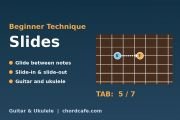
In tablature a slide is usually written with / for sliding up (toward higher frets) and \ for sliding down. For example, 5/7 means pick fret 5 and slide up to fret 7. Some tabs use the letter s instead, as in 5s7.
Types of slides every beginner should know
- Legato slide: pick the first note once, then slide to the second. The second note sounds only from the string's remaining vibration.
- Shift slide: slide the same way, but pick again when you arrive at the target fret, so the second note is clearer and stronger.
- Slide-in: start from an undefined spot two or three frets below or above the target and glide into it. It works like a vocal scoop into a note.
- Slide-out: after playing a note, slide down the neck while slowly easing pressure, so the sound fades away. Great for ending a phrase.
How to play a clean slide, step by step
- Use the right pressure. Press about as hard as you would for a normal note. Too light and the note dies halfway; too hard and your finger drags.
- Move your whole hand. Let your wrist and arm carry the hand, with your thumb sliding along the back of the neck. This makes landing on the target much more accurate.
- Look at the destination. Keep your eyes on the fret you are heading to, not the one you started from.
- Stop just behind the fret wire. Land in the same spot you would fret a normal note so the pitch is clean and in tune.
- Keep it in time. The target note should land on the beat you intend, so practise slides with a metronome.
A simple guitar exercise
On the 3rd string (G), pick fret 5 and slide up to fret 7, letting it ring. Then pick fret 7 and slide back down to fret 5. Repeat slowly with your ring finger. Once that feels comfortable, try it inside the A minor pentatonic scale, adding slides between frets 5 and 7 on the 4th and 3rd strings. You will hear that familiar blues and rock flavour right away.
A simple ukulele exercise
On the A string (1st string), pick fret 3 and slide to fret 5, then pick fret 5 and slide to fret 7 to make a short melody. The ukulele's neck is shorter and its frets closer together, so the distances are smaller; be careful not to overshoot. Try a slide-in on the first note of a melody you like, and you will notice how much smoother ukulele melodies sound.
Common beginner mistakes
- The note dies mid-slide: usually you are releasing pressure while moving. Go slowly and keep the pressure steady.
- Overshooting or falling short: start with two-fret slides, then stretch to three, four and five frets.
- Sticky or sore fingers: old strings and sweaty hands create drag. Wipe the strings and your hands, or put on fresh strings.
- Sliding into every note: a slide is seasoning. Use it where you want a phrase to feel expressive; too many make the music sound smeared.
Wrapping up
Slides are quick to learn, yet they make your playing sound more polished almost immediately. Start with short, slow slides, focus on steady pressure and your destination fret, and practise a few minutes a day with a metronome. Soon you will be adding slides to the melodies and solos of your favourite songs naturally. Open the chords and tabs of a song you love on Chordcafe and look for spots where a slide fits.