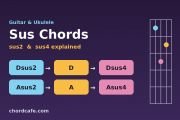
Have you ever seen chord names like Dsus4, Asus2 or Gsus in a song sheet and wondered what "sus" means? These are suspended chords, often called sus chords. They are easy to play and add a lot of colour to simple songs. Everything in this guide works on both guitar and ukulele.
What is a suspended chord?
A normal major or minor chord (a triad) has three notes: the root, the third and the fifth. The third is the note that decides whether a chord sounds major (happy, bright) or minor (sad, dark). In a suspended chord, the third is removed and replaced with either the second or the fourth note of the scale.
- sus2: root, 2nd and 5th. Csus2 = C, D, G
- sus4: root, 4th and 5th. Csus4 = C, F, G
Because there is no third, a sus chord is neither major nor minor. It sounds open and a little "unfinished", as if it is waiting to go somewhere. That feeling of being held in the air is where the name "suspended" comes from. When a chord sheet just says "sus", for example Gsus, it normally means sus4.
How sus chords sound
- sus4 has a strong pull. The 4th wants to fall back down to the 3rd, so Dsus4 naturally resolves to D.
- sus2 is softer and more airy. It does not pull as hard, so it can be held for a long time and works well in ballads and acoustic pop.
The classic move is to play the sus chord and then return to the normal chord: D, Dsus4, D. This little "tension and release" makes a plain strumming pattern sound much more interesting.
Easy sus chords on guitar
Shapes are written from the low E string (6th) to the high E string (1st). x = do not play, 0 = open string.
- D = xx0232, Dsus2 = xx0230, Dsus4 = xx0233
- A = x02220, Asus2 = x02200, Asus4 = x02230
- E = 022100, Esus4 = 022200
- Csus2 = x30013, Csus4 = x33011
- Gsus4 = 330013
Notice how small the changes are. From an open D chord you only lift or add one finger on the high E string to get Dsus2 or Dsus4. The same is true for A on the B string.
Easy sus chords on ukulele
Shapes are written from the G string (4th) to the A string (1st) in standard GCEA tuning.
- C = 0003, Csus2 = 0233, Csus4 = 0013
- G = 0232, Gsus2 = 0230, Gsus4 = 0233
- D = 2220, Dsus2 = 2200, Dsus4 = 0230
- A = 2100, Asus4 = 2200
You may notice that some shapes share the same notes. For example, Csus2 (C, D, G) and Gsus4 (G, C, D) contain exactly the same three notes, so on ukulele they use the same shape. Which name is correct depends on the song: the chord is named after the key centre and the chords around it.
Where to use sus chords
- Decorate a long chord. If a song stays on D for a whole bar or more, try D for two beats and Dsus4 for two beats, then back to D.
- Build up before the chorus. Playing the V chord as sus4 and then resolving, for example Gsus4 to G in the key of C, creates tension that leads nicely into the next section.
- Fingerpicking intros. Switching between Asus2, A and Asus4 while picking gives a moving melody on top without changing the bass note.
sus2 vs add9: what is the difference?
These two are often confused. Csus2 has no third (C, D, G). Cadd9 keeps the third and adds the 9th, which is the same note name as the 2nd (C, E, G, D). So Cadd9 still sounds major, while Csus2 sounds neutral. You may also see 7sus4 chords such as G7sus4, which add the flat 7th to a sus4 chord.
A simple practice routine
- Play D, Dsus4, D, Dsus2 slowly with one strum each, and listen to how each chord feels.
- Repeat with A, Asus4, A, Asus2 on guitar, or C, Csus4, C, Csus2 on ukulele.
- Use a metronome at a slow tempo and keep your strumming hand moving while only one finger changes.
- Pick a song you already know, find a chord that lasts a full bar, and add a sus4 before resolving.
Suspended chords are one of the quickest ways to make simple chords sound richer without learning difficult new shapes. Start with D and A on guitar or C and G on ukulele, and try adding them to the songs you play on Chordcafe today.